Performance Analysis
SEO: Stop Using the Google Disavow Tool for “Toxic” Links


TL;DR:
Don’t use Google’s Disavow Tool simply because Semrush or another SEO tool has labelled backlinks as “toxic”. Google says most websites don’t need to disavow links, and using the tool incorrectly can potentially harm search performance. In this case study, disavowing thousands of supposedly toxic domains didn’t produce the expected recovery, demonstrating why you should investigate the actual cause of an organic traffic decline before assuming backlinks are responsible.
Why I started looking into toxic backlinks and disavow files
Over the years as a freelance SEO consultant, I’ve been added to the Google Search Console accounts of hundreds of clients, so I receive GSC notifications on a regular basis.
I received one recently that I’d not seen in a while but one which, when I do see it, makes a little bit of me die inside.
This one:
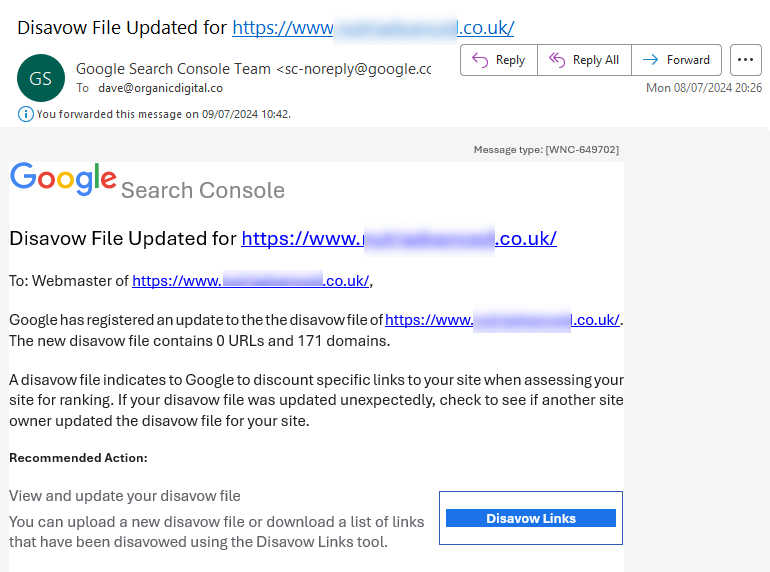
I immediately contacted the client and told them not to go any further until we’d reviewed what had been disavowed.
Why? Because for most websites, Google says you don’t need to use the Disavow Tool simply because an SEO tool has labelled some of your backlinks “toxic.”
Google says most sites don’t need the tool and warns that using it incorrectly can potentially harm a site’s performance in Search. It should be reserved for situations where you have a considerable number of spammy, artificial or low-quality links and those links have caused, or are likely to cause, a manual action.
Before getting into the case study, it’s worth explaining what the Google Disavow Tool actually does and why it exists.
What is the Google Disavow Tool?
Google’s Disavow Tool allows you to submit a text file containing pages or domains whose backlinks you want Google to disregard when assessing your site.
It is an advanced tool rather than a routine backlink-cleaning feature. Google explicitly says that most sites won’t need to use it and warns that incorrectly disavowing links can harm your site’s performance.
Google introduced the Disavow Tool in 2012, when manipulative link building was widespread and Google’s Penguin updates were targeting sites using link schemes to influence rankings.
At the time, cleaning up a backlink profile and disavowing links that couldn’t be removed became part of recovering from link-related penalties.
Search has changed considerably since then. Google says that in most cases it can now assess which links to trust without additional guidance from the site owner.

There are indications that Google may eventually phase out the Disavow Tool entirely as their algorithms continue to improve in identifying and ignoring spammy backlinks on their own, again, as stated by John:

When should you use the Google Disavow Tool?
Despite the warnings around using it, there are situations where Google’s Disavow Tool may still be appropriate.
Google’s guidance says you should only consider disavowing backlinks when both of the following apply:
- You have a considerable number of spammy, artificial or low-quality links pointing to your site; and
- those links have caused a manual action, or are likely to cause one.
If you’ve previously been involved in paid links, link schemes or other manipulative link building, that’s very different from discovering that a third-party SEO tool has classified some of your naturally acquired backlinks as “toxic”.
And that’s where I think much of the confusion around disavowing links comes from.
Why do people still disavow “toxic” backlinks?
One reason is that third-party SEO platforms provide backlink auditing tools that classify links using their own toxicity or risk metrics.
In this case, I’m going to use Semrush as an example. Its Backlink Audit tool reviews links and can classify them as toxic or potentially toxic, which can understandably make site owners think those links need to be removed or disavowed.
Here’s an example from my own domain:

In this example, Semrush classified 23.2% of my backlinks as toxic or potentially toxic.
If I’d recently seen a drop in organic traffic, it would be very easy to look at that percentage and conclude that these “toxic” backlinks might be responsible.
I could then make the potentially damaging assumption that I should disavow them.
But a third-party toxicity score isn’t the same thing as Google telling you that those links are harming your site.
In fact, Semrush considers my site’s overall backlink profile to have low toxicity. Here’s my site alongside several others in the same account, some of which the tool classifies as having high toxicity:

Seeing a site labelled high toxicity can understandably be alarming, particularly if you’ve also seen rankings or organic traffic decline. That’s where a third-party metric can start influencing a decision to disavow links, even though Google hasn’t indicated that those links are causing a problem.
And I’ve seen exactly that happen.
A client of a client had seen a drop in rankings and, concerned that their increasing number of “toxic” backlinks might be responsible, carried out a backlink audit.
Rather than first establishing whether the ranking decline was actually being caused by links, they went ahead and disavowed the backlinks the tool had classified as toxic.
Ranking and traffic declines can have many other causes, including indexing problems, technical issues, content quality or changes in the search results, so making that connection based on a toxicity score alone can be risky.
The first large batch of links was disavowed between December and January, which you can see in the backlink audit history below:

By January, the report was showing no toxic or potentially toxic backlinks.
So, if those “toxic” links had been responsible for the site’s declining visibility, you might expect performance to start recovering.
But that’s not what happened.
After the familiar seasonal drop in December, organic clicks didn’t recover in January. They continued to decline through to April.

That doesn’t prove that disavowing the links caused the decline. What it does show is that removing the links classified as toxic didn’t produce the recovery that was expected.
At this point, the number of disavowed domains had increased from 910 to 1,581. When performance still hadn’t recovered by April, even more domains were added to the disavow file, eventually bringing the total to 5,889:

and confirmed here:

Did disavowing the toxic backlinks work?
In this case, no. The initial removal of the links classified as toxic didn’t coincide with the expected recovery, and increasing the number of disavowed domains didn’t address the underlying decline either.
That’s not evidence that using the Disavow Tool will always cause rankings or traffic to fall. There were other factors affecting this site’s performance, and the timing alone doesn’t establish causation.
The important point is that a third-party tool labelling backlinks as “toxic” wasn’t evidence that those links were responsible for the original decline. Disavowing thousands of domains therefore wasn’t a substitute for investigating what was actually affecting the site’s organic performance.
Should you disavow toxic backlinks reported by Semrush?
I wouldn’t disavow backlinks simply because Semrush, or any other third-party SEO platform, has classified them as toxic.
Those scores can be useful as a starting point for investigating a backlink profile, but they’re not a Google penalty notification and they don’t tell you that Google is using those particular links against your site.
Don’t disavow backlinks simply because an SEO tool has labelled them “toxic”.
Google’s own guidance says that most sites don’t need to use the Disavow Tool. If you have a genuine history of manipulative link building, a manual action, or a considerable number of artificial links that could realistically lead to one, that’s a different situation. Otherwise, I’d be very cautious about uploading a disavow file based purely on a third-party toxicity score.
If you’re seeing a drop in organic visibility, don’t assume that a rising toxicity score is the explanation. Investigate what has actually changed before disavowing links that may be doing your site no harm, and could potentially be helping it.
If you’re concerned about a drop in visibility and aren’t sure what’s causing it, there may be other SEO issues worth investigating before you start disavowing backlinks.

categories
- Analytics Insights
- Crawl Rate Insights
- Ecommerce SEO Insights
- International SEO Insights
- Keyword Research Insights
- Local SEO Insights
- Migrations Insights
- News Insights
- On Page SEO Insights
- Performance Analysis Insights
- SEO Audits Insights
- Site Speed Insights
- Structured Data Insights
- Tag Manager Insights
- Wordpress SEO Insights
latest posts
How To: Track GA4 AI Assistant Traffic, Including Historical Data

A Rough Guide To: LLMS.txt - What It Is & How To Create One
How To: Build SEO Content Hubs for Topical Authority

Case Study: Do Keywords in URLs Help SEO Rankings?

How To: Track Google Business Profile Traffic in GA4

get in touch
If you need some expert website optimisation and configuration, want to find out more, or even just have a question, fill in the form below as I will always be happy to help