On Page SEO - Crawl Rate
A Rough Guide To: LLMS.txt


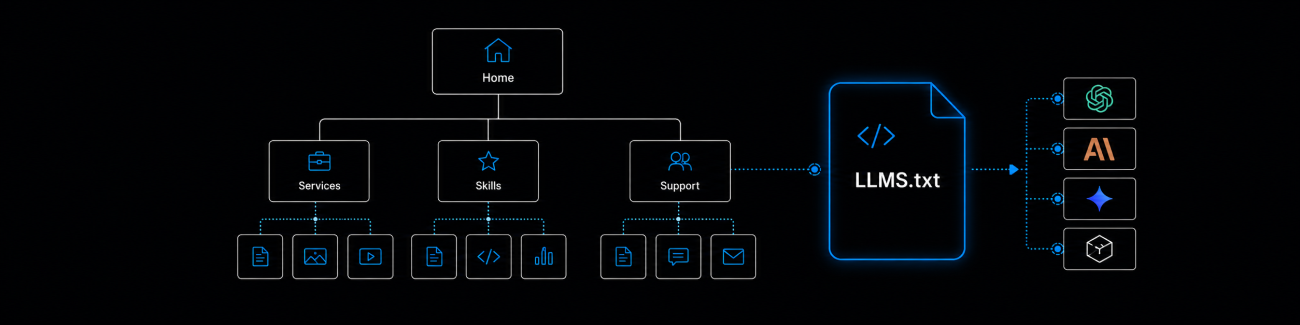
TLDR: It’s basically an XML sitemap that looks like a robots.txt
LLMS.txt is one of the latest ideas to emerge from the crossover between SEO, AI search, and large language models.
Some people are treating it as the next big ranking factor. Others are dismissing it completely.
As with most things in SEO and website optimisation, the reality sits somewhere in the middle.
LLMS.txt is not a magic solution. It is not an AI ranking boost. It is not a shortcut into ChatGPT, AI Overviews, Claude, Gemini, or Perplexity.
But it is a potentially useful way to help AI systems better understand the structure, priority, and purpose of your content.
Think of it more like a directive or reference file. Closer in spirit to an XML sitemap than a ranking factor.
It gives AI systems a cleaner, simplified overview of your content and website structure.
Whether those systems choose to use it is entirely up to them.
What Is LLMS.txt?
LLMS.txt is a plain text or markdown-style file designed to help Large Language Models (LLMs) understand a website.
The idea is simple:
Instead of forcing AI systems to crawl and interpret an entire website structure themselves, you provide a curated summary of:
- What your site is about
- Your key topic areas
- Important pages
- Supporting resources
- Expertise areas
- Content relationships
In many ways, it acts as a simplified knowledge map of your website.
Typically, the file sits at:
/llms.txt
For example:
https://daveashworth.co/llms.txt
The format is intentionally lightweight and human readable.
What LLMS.txt Is NOT
This is the important bit.
LLMS.txt is not:
- A guaranteed ranking factor
- An SEO shortcut
- A way to force inclusion in AI Overviews
- A way to increase traffic from ChatGPT
- A way to guarantee citation by AI systems
- A replacement for proper SEO
- A replacement for content quality
- A replacement for crawlability, internal linking, or structured data
A lot of online discussion around AI search currently falls into the category of “new acronym syndrome”.
AEO. GEO. AI SEO. Answer optimisation. Generative optimisation.
Some of it is useful. Some of it is recycled SEO advice. Some of it is complete guesswork.
Google themselves recently addressed this directly in their AI Optimisation Guide.
In the section “Mythbusting generative AI search: what you don’t need to do” they state:
“LLMS.txt files and other ‘special’ markup: You don’t need to create new machine readable files, AI text files, markup, or Markdown to appear in generative AI search.”
That is important context.
Google are effectively saying:
- LLMS.txt is not required for visibility in Google Search
- LLMS.txt is not required for AI Overviews
- Google does not currently treat it as special ranking markup
That makes sense.
Google has spent decades building systems to understand websites without needing website owners to hand-feed them simplified summaries.
But Google Isn’t The Only Player
This is where the conversation becomes more interesting.
Even if Google ignores LLMS.txt entirely, Google is not the only AI ecosystem.
We are now dealing with:
- ChatGPT
- Claude
- Gemini
- Perplexity
- Meta AI
- Mistral
- Enterprise AI systems
- Retrieval systems
- AI agents
- Custom LLM implementations
Some of these systems:
- Crawl differently
- Process information differently
- Retrieve context differently
- Prefer simplified structured content
- Work with markdown particularly well
So while there is no guarantee that any AI platform will use LLMS.txt directly, there is also no guarantee they won’t.
And importantly:
A well-structured summary of your website is rarely a bad thing.
Think Of It Like An XML Sitemap
The easiest way to think about LLMS.txt is this:
An XML sitemap helps search engines discover URLs.
LLMS.txt potentially helps AI systems understand:
- Topics
- Relationships
- Priorities
- Expertise
- Context
- Website structure
An XML sitemap does not guarantee rankings.
Likewise:
LLMS.txt does not guarantee:
- AI citations
- AI traffic
- Better rankings
- More visibility
- More inclusion in AI-generated answers
But both can help provide cleaner signals.
That is the key distinction.
Why Structure Matters More Than Ever
Whether AI systems directly use LLMS.txt or not, one thing is becoming increasingly clear:
Website structure matters.
Content relationships matter.
Topic clustering matters.
Internal linking matters.
Entity understanding matters.
Semantic clarity matters.
This is one reason why content hub structures have become more important over time.
A well-organised website naturally helps:
- Search engines
- Users
- Accessibility systems
- AI crawlers
- Retrieval systems
- Knowledge graph extraction
LLMS.txt simply becomes another layer that can reinforce that structure.
Different Ways To Structure LLMS.txt
There is no universally accepted standard.
That means you can keep things very simple or build something much more extensive.
Simple LLMS.txt Example
A basic version may simply summarise the website and list key pages.
# Website Name

> Short description of the website and what it covers. This website covers SEO, analytics and ecommerce. Use the links below to understand the main services, background information and supporting articles.

## Core Pages

- [Services](https://example.com/services/): Main services offered by the business.
- [About](https://example.com/about/): Background information about the business or person behind the website.
- [Blog](https://example.com/blog/): Supporting articles, guides and resources.

## Key Topic Pages

- [SEO](https://example.com/seo/): Information about SEO services, guides and related resources.
- [Analytics](https://example.com/analytics/): Information about analytics, tracking and reporting.
- [Ecommerce](https://example.com/ecommerce/): Information about ecommerce optimisation and support.
This acts more like a lightweight overview document.
Medium Complexity LLMS.txt
A more developed version may include:
- Topic groupings
- Service categories
- Key articles
- Supporting resources
- Relationships between sections
For example:
# Ecommerce SEO

## Core Pages

- Shopify SEO

- Magento SEO

- WooCommerce SEO

## Supporting Articles

- Canonicalisation guides

- Crawlability guides

- Product metadata optimisation
This starts to resemble a content hub map.
Extensive LLMS.txt Structures
The most advanced versions go much further.
These may include:
- Full topic clustering
- Content relationships
- Hierarchical structures
- Supporting content by theme
- Entity references
- Service relationships
- Technical capability summaries
- Website architecture summaries
- Expertise mapping
This is the approach I have taken with my own LLMS.txt file.
Rather than simply listing URLs, the file mirrors the broader content hub and internal linking structure across the website.
It groups:
- Services
- Skills
- Support pages
- Technical expertise
- Supporting blog content
- Topic clusters
The idea is not to “game” AI systems.
The goal is simply to provide:
- Clarity
- Structure
- Relationships
- Context
- Priority
Essentially, it acts as a high-level map of the website – I’ll not paste it all into this blog, so you can view it here:
https://daveashworth.co/llms.txt
My Approach To LLMS.txt
My own implementation evolved naturally from broader content hub optimisation work.
Over time, I have been organising the website around:
- Core service pages
- Supporting skill pages
- Clustered blog content
- Internal linking relationships
- Topic authority
- Semantic relevance
The LLMS.txt file became an extension of that structure.
Not because I expect rankings from it.
But because:
- It creates a cleaner overview of the website
- It reinforces topical relationships
- It summarises expertise areas clearly
- It helps define content clusters
- It creates a simplified machine-readable reference point
Even if AI systems only partially use it, the underlying structure itself is still beneficial.
What Probably Matters More Than LLMS.txt
If you are thinking about AI visibility, retrieval systems, or generative search, these things likely matter far more:
- Strong technical SEO
- Crawlability
- Internal linking
- Clear site architecture
- Semantic relevance
- Topic clustering
- Helpful content
- Brand mentions
- Structured data
- Fast websites
- Trust signals
- Consistent expertise
- Clear entity relationships
LLMS.txt does not replace any of these.
If anything, it works best because those things already exist.
Should You Create One?
Personally, I think there is very little downside.
A lightweight LLMS.txt file is:
- Easy to create
- Easy to maintain
- Low risk
- Helpful for documenting structure
- Potentially useful for AI systems
But expectations need to stay realistic.
Once again, I will say you should not expect:
- Ranking boosts
- AI traffic spikes
- Guaranteed citations
- Instant visibility improvements
Instead, think of it as:
A sensible supporting layer.
Not a silver bullet.
What This Really Comes Down To
The AI search landscape is evolving extremely quickly.
Some ideas will prove valuable. Some will disappear. Some will become standard practice. Some will turn out to be noise.
Right now, LLMS.txt sits somewhere in the middle.
Google have openly stated they do not require it.
But Google is only one ecosystem.
And as AI retrieval systems continue to evolve, providing clear, structured summaries of website content feels like a sensible direction regardless.
At worst:
You create a cleaner map of your website.
At best:
You provide AI systems with a stronger foundation for understanding your content, expertise, and topical relationships.
And in modern SEO and website optimisation, clarity and structure are rarely wasted effort.

categories
- Analytics Insights
- Crawl Rate Insights
- Ecommerce SEO Insights
- International SEO Insights
- Keyword Research Insights
- Local SEO Insights
- Migrations Insights
- News Insights
- On Page SEO Insights
- Performance Analysis Insights
- SEO Audits Insights
- Site Speed Insights
- Structured Data Insights
- Tag Manager Insights
- Wordpress SEO Insights
latest posts
How To: Report GA4 AI Assistant Traffic Historically

How To: Build Topical Authority With Content Hubs

Case Study: Do Keywords in URLs Impact SEO & Rankings?

How To: Track Google Business Profile Listing Traffic

How To: Track Internal Link Clicks in Google Analytics 4 via GTM

get in touch
If you need some expert website optimisation and configuration, want to find out more, or even just have a question, fill in the form below as I will always be happy to help