On Page SEO - Structured Data
How To: Optimise Your Website For AI, ChatGPT, Gemini Et Al



During my years as an SEO Consultant, there has always been questions raised about how to best optimise your site whilst taking in the potential differences in how various search engines choose to rank sites. Of course it’s always been about ranking well on Google, no one really cared about optimising for Bing, but, it was a valid question none the less.
What “Optimisation” Used To Look Like
Once upon a time, all you had to do was spin as much low-quality content as you could, generate as many links as you could, and then watch. It tended to work.
However, in the pre-Panda and Penguin world, my viewpoint has always been you don’t need to do anything different and just follow the fundamentals of a well optimised, technically sound website.
Google always said content was king, and I think that’s always been the case. As an ex-web developer, I’ve always been a fan of the technical aspects of optimisation and know that once you have your site structure and content nailed, if you then implement high quality site speed, crawl rate and schema optimisation, you will see positive results.
Links help of course, though I’ve never actively engaged in link building of any sort. My profile is ok; I’ve picked up links from decent sites mainly via writing insightful and useful content.
I’ve always been more focused on getting good reviews on my Google Business profile and using schema to show which reviews are for which services I offer.
And my service pages and blog content rank well for the key terms I optimised them for. It drives traffic which generates leads for my services, and engagement on my blog content.
I’ve never gave AI a second thought in terms of what I’d need to do to rank.
Then it became apparent that ChatGPT was noticing me.
Case Study: Getting Leads From ChatGPT
I track all the leads I get to see where the users come from. A email recently landed in my inbox that told me it came from ChatGPT. This was a first, so I asked the guy who got in touch if he could share some insights into how that came about.
Fortunately, he was able to send the shared conversation link:
https://chatgpt.com/share/68ee307c-3fc4-800d-8c9b-d5119013b8eb
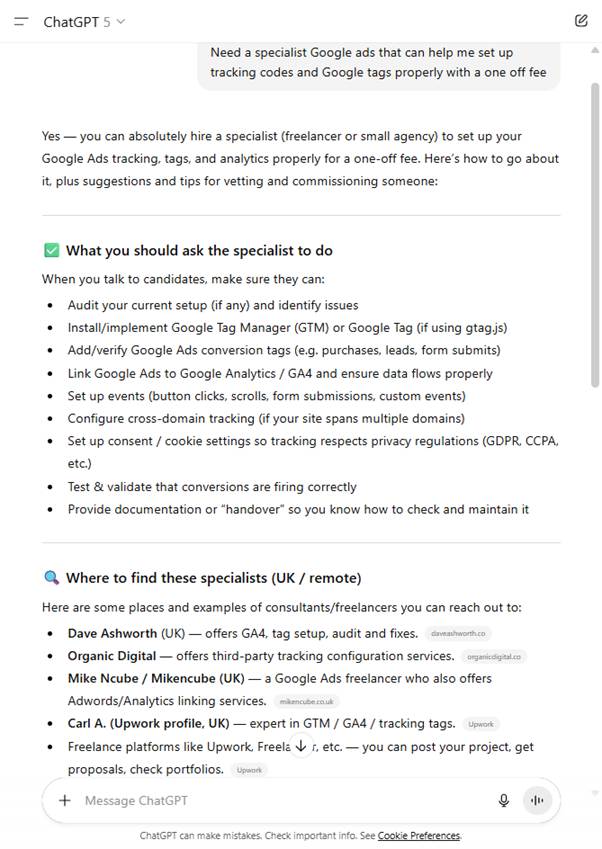
What I find most interesting about that is that only did it list my current site first, the second recommendation is my old site, which I recently migrated to this site following a rebrand.
So presumably it’s crawled my old site, saved it as a reference point, then found my new site, and found that to be of the same high standard, but doesn’t process redirects in the same way as search engines.
Anyway, how nice.
Case Study: Getting Links From ChatGPT
When I was carrying out my recentl monthly site performance audit and analysis, I noticed a link being reported in GSC from ChatGPT.

Again, this was from a conversation as follows:
https://chatgpt.com/share/68dce613-58a8-800c-93da-2f1692d6374b
Someone is looking for links to pendant lights and asked what the srsltid parameter is all about:

And ChatGPT found the answer in my blog post here:
Solved: What Is The srsltid URL Parameter?
I think what I find most interesting about all this is that Google is crawling and indexing ChatGPT conversations, and taking note of the links within.
So…
How Do You Optimise Your Site For AI?
For me, the answer is still fairly simple – nothing has changed: good quality on-page optimisation, strong technical foundations, useful content and a website that clearly explains who you are, what you do and why someone should trust you.
That might sound boring, especially when people are now talking about AI SEO, AEO, GEO, AI Overviews, ChatGPT optimisation, Gemini optimisation and whatever the next phrase ends up being.
But a lot of the work underneath is the same.
The search experience is changing. The way people ask questions is changing. The places they search are changing. But if you want your website to be found, understood, trusted, cited or recommended by any search or AI system, you still need to make sure your content is clear, useful, crawlable and credible.
That applies whether someone finds you through a traditional Google search result, an AI Overview, ChatGPT, Gemini, Perplexity or any other AI-led search experience.
The labels might be different. The basics are not.
AI SEO, AEO, GEO — are they all the same thing?
Not exactly.
AI SEO
This is probably the broadest term. It’s the one most businesses are likely to understand because it connects something familiar, SEO, with something they know is changing, AI.
AEO, or Answer Engine Optimisation
This is usually about making sure your content can answer specific questions clearly. That could mean being pulled into featured snippets, AI Overviews, voice search-style answers, or other answer-led search results.

GEO, or Generative Engine Optimisation
is more focused on visibility inside generative AI tools and AI-generated responses.
So yes, they are different in theory.
But in practice, there is a huge amount of overlap.
All of them depend on whether your website can be discovered, understood and trusted. They all rely on clear content, useful answers, good structure, technical accessibility and signals that help search engines and AI systems understand your business.
This is why I don’t think the argument about whether GEO is “just SEO” is all that useful.
From a client’s or user’s point of view, it feels different. They are not just typing keywords into Google anymore. They are asking longer questions. They are comparing options. They are asking AI tools to explain, recommend, summarise and shortlist.
So yes, we need to talk about AI optimisation because that is how people are now talking about the problem.
But we also need to be honest about what the work actually involves.
And most of the time, it is not magic. It is not a new file you upload. It is not stuffing your website with AI-friendly phrases. It is not creating hundreds of thin pages for every possible question someone might ask.
It is proper SEO, proper content and proper website optimisation, applied to a changing search landscape.
My own example
My Google Analytics page, like the other service pages on my site, has the basics covered.
- It has an optimised title tag
- It has an optimised H1 tag
- It has an optimised meta description
- It has clear, straight-to-the-point content
- It has a visible testimonial
- It has schema markup, including Product, Reviews and Breadcrumbs
- It has strong site speed and Core Web Vitals scores
- It is internally linked from relevant pages
- It explains what I do in plain language
What it does not have is a load of pointless SEO filler.
I’ve no time or inclination to pad out a page with questions like “What is an analytics consultant?” or “What does an analytics consultant do?” if they are only there because someone thinks every service page needs an FAQ section.
That is not useful. It is just noise.
The page exists to explain the service clearly, show that I know what I’m doing, and make it easy for someone to understand whether I can help them.
- That is good for users
- That is good for SEO
- And, I would argue, that is also good for AI visibility
The same applies to the blog post that started generating leads for me.
That article was not written to “game” AI. It was written to answer a very specific question: What is the srsltid URL parameter?
- It had a clear topic
- It answered the question directly
- It explained the issue in plain language
- It came from real experience
- It was crawlable, indexable and easy to understand
I don’t know exactly how ChatGPT, Gemini or any other AI system decides which sites to trust, cite or use in a response. I don’t know the full mechanics of how each tool crawls the web, stores information, retrieves sources or ranks possible answers.
And honestly, I’m not too worried about knowing every detail.
Because I already know what makes a website worth understanding, trusting and referencing.
If your website has useful content, technical clarity, genuine expertise and a consistent presence around a topic, you are giving yourself a much better chance of being included wherever search goes next.
What should you actually do?
The best approach is to focus on the things that make your website easier to understand, easier to trust and more useful to visitors.
That starts with being crawlable and technically clean.
Your important pages need to be accessible to search engines. They need to load properly. They need to be indexable. Your internal links need to help people and search engines move through the site. Your content should not be hidden behind awkward JavaScript issues or blocked resources. Your structured data should support what is already on the page, not try to invent things that are not there.
Then you need clear, useful content.
Not vague waffle. Not copied summaries of what everyone else has already said. Not thin “SEO content” that exists only because a keyword tool said so.
AI systems are increasingly being used to summarise, compare and recommend. If your content says the same thing as every other page, why would it be chosen? Why would it be cited? Why would it be trusted?
This is where non-commodity content matters.
Use your own experience. Give examples. Explain what you have seen. Add opinion where it is useful. Show the reader how something applies in the real world.
- That might be a case study
- It might be a practical walkthrough
- It might be a comparison based on your own experience
- It might be a section that says, “Here’s what I would actually do”
That kind of content is much harder to replace with a generic AI summary because it contains something specific to you.
You also need clear structure.
I don’t mean chopping content into tiny artificial chunks because someone on LinkedIn said AI prefers it. I mean using headings properly. Keeping sections focused. Making pages easy to scan. Helping people quickly understand what a page covers and where the useful information is.
- That is good writing
- It is good UX
- It is good SEO
- And it makes sense for AI-led search too
You should also build topical depth across your site.
That is where content hubs come in.
One article on its own can rank, but a well-connected set of pages around a topic can do much more. It helps users explore a subject properly. It helps search engines understand what you specialise in. It gives AI systems more context about your expertise.
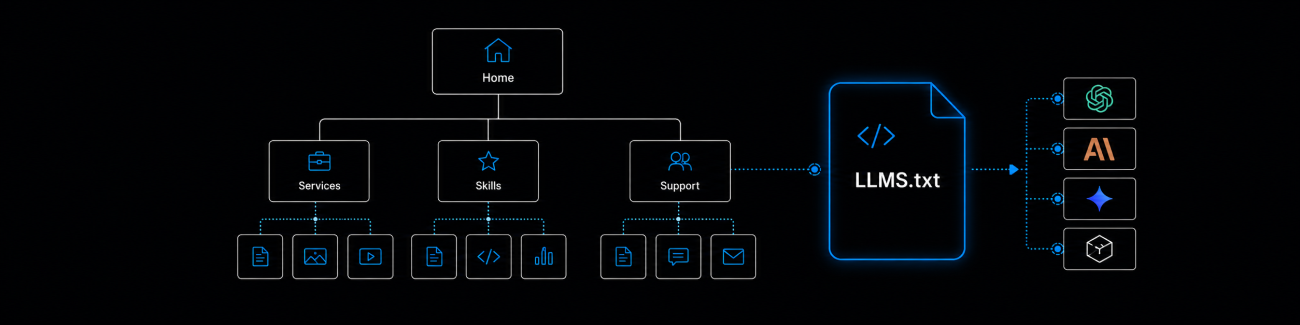
That is why I’ve been working on content hubs across my own site. The aim is not just to publish more articles. It is to connect service pages, skills pages and supporting blog posts in a way that makes sense.
For AI optimisation, this is especially important.
- A standalone article on LLMS.txt is useful
- A standalone article on content hubs is useful
- A standalone article on optimising for AI is useful
But together, connected properly, they become much stronger. They start to show a clear area of expertise around AI visibility, content structure, technical SEO and how websites are understood by search engines and AI tools.
That is the bigger picture.
What should you not do?
This is where it is easy to get distracted.
- You do not need to panic-create an LLMS.txt file and assume that will make your website appear in AI answers. I’ve written separately about LLMS.txt, and while I think it is interesting, it is not a magic AI SEO switch.
- You do not need to rewrite your entire website in some strange “AI-friendly” format
- You do not need to create hundreds of pages targeting every possible long-tail question, fan-out query or AI prompt variation
- You do not need to add fake FAQs just because you think AI wants question-and-answer formatting
- You do not need to chase inauthentic mentions across the web in the hope that AI tools will start repeating your brand name
- You do not need to overdo schema markup and expect it to force your way into generative search results
- And you definitely should not be trying to manipulate AI responses
Google has already been clear that attempting to manipulate generative AI responses in Google Search can fall under spam. That matters, because the same old SEO problem is already starting to appear in a new wrapper.
People are taking a genuine change in search behaviour and turning it into a list of shortcuts.
- Create this file
- Add this markup
- Chunk your content like this
- Mention these entities
- Build these fake citations
- Create pages for every prompt
That is not a strategy. That is just AI-era spam.
The better approach is much less exciting, but much more useful.
- Make your website technically sound
- Make your content genuinely helpful
- Make your expertise obvious
- Make your pages easy to understand
- Make your site structure logical
- Make sure your business details are consistent
- Use schema where it genuinely supports the content
- Create content that deserves to be referenced
That is the work.
the role of trust
Trust is going to matter more, not less.
If AI tools are summarising information, recommending businesses or pulling together answers from multiple sources, then credibility becomes a big part of the picture.
That does not mean you need to pretend to be a massive brand. It means you need to make the trust signals you already have easier to find.
- Who wrote the content?
- Why should they be trusted?
- What experience do they have?
- Is the business real?
- Are the reviews visible?
- Are the contact details clear?
- Do other pages on the site support the same area of expertise?
- Does the content feel like it was written by someone who knows the subject?
For service businesses, that can include testimonials, case studies, author information, client examples, clear service descriptions and useful supporting articles.
For ecommerce sites, it can include product information, reviews, delivery details, returns information, FAQs that actually answer buying objections, high-quality images and clean product data.
For local businesses, it can include consistent business details, Google Business Profile optimisation, local landing pages, reviews, opening hours, service areas and proper LocalBusiness schema.
Again, none of this is brand new.
But AI search makes it even more important because your website may not always be judged in isolation. It may be compared, summarised or used as one source among many.
Be direct, useful and human
The more I look at AI search, the more I come back to the same few principles.
Be crawlable and technically clean.
That means structured data where useful, good site speed, sensible internal linking and no obvious technical barriers.
Be trustworthy and consistent.
That means good reviews, credible content, clear business information and matching details across the platforms that matter.
Be direct and useful.
Answer the question in plain language. Get to the point. Don’t hide the useful bit under 800 words of setup. And never mind the bollocks like FAQ padding for the sake of it.
Be human.
Use genuine tone. Show your experience. Add your own view. Make it clear there is a person, team or business behind the content.
Same Foundations, New Search Landscape
If AI tools can recognise all of that, you are probably doing the right things.
And if they cannot recognise it yet, it is still the right thing to do for your users and for traditional SEO.
That is why I do not see AI optimisation as a replacement for SEO. I see it as another layer on top of the same foundations.
Search is changing. The language is changing. The way people discover businesses is changing.
But websites still need to be useful, accessible, trustworthy and clear.
That has always been the job. AI just makes the weak spots harder to ignore.

categories
- Analytics Insights
- Crawl Rate Insights
- Ecommerce SEO Insights
- International SEO Insights
- Keyword Research Insights
- Local SEO Insights
- Migrations Insights
- News Insights
- On Page SEO Insights
- Performance Analysis Insights
- SEO Audits Insights
- Site Speed Insights
- Structured Data Insights
- Tag Manager Insights
- Wordpress SEO Insights
latest posts
How To: Report GA4 AI Assistant Traffic Historically

A Rough Guide To: LLMS.txt
How To: Build Topical Authority With Content Hubs

Case Study: Do Keywords in URLs Impact SEO & Rankings?

How To: Track Google Business Profile Listing Traffic

get in touch
If you need some expert website optimisation and configuration, want to find out more, or even just have a question, fill in the form below as I will always be happy to help